AI for RBI Compliance: Grounded Answers for Banks and NBFCs

How purpose-built, citation-backed AI changes the daily work of compliance teams
A compliance team at an Indian bank or NBFC answers questions all day. Does this product feature follow the latest KYC norms? Which Master Direction governs this exposure? Did last month's circular change our reporting obligation? Each answer has to be right, current, and defensible to an auditor or regulator.
The raw material for those answers keeps growing. The Reserve Bank of India issues circulars, Master Directions, notifications, and amendments on a schedule no individual can fully track, and every institution layers its own policies, SOPs, and product documentation on top. The knowledge exists. Finding the right version of it, quickly and verifiably, is the problem.
The regulatory knowledge problem
Compliance knowledge in a financial institution is scattered across two bodies of text that must be read together. The first is regulatory: RBI circulars and Master Directions, amended over the years, where the applicable rule is the net result of a chain of documents. The second is internal: the institution's own policies and procedures, which implement, and sometimes exceed, the regulatory baseline.
Answering a real question means locating the right clause in the right version of the right document, in both bodies at once. Done manually, that is slow for experts and risky for everyone else. The practical consequences are familiar: queues of questions waiting on a small compliance team, inconsistent answers across departments, and decisions made on a colleague's recollection of a circular rather than the circular itself.
Why a generic AI chatbot is not the answer
General-purpose AI assistants look like an obvious fix, and for regulated institutions they fail in four specific ways:
- No grounding. Generic models answer from training memory and will produce fluent, plausible text even when they do not hold the fact. In compliance, a confidently wrong answer is worse than no answer.
- No citations. A compliance answer that cannot be traced to a source document cannot be defended in an audit. Verifiability is not a nice-to-have; it is the product.
- Stale knowledge. Models are trained to a cutoff date. Regulation does not stop at that date, and an assistant quoting a superseded circular is a liability.
- Data residency. Internal policies and the questions employees ask about them are sensitive. Sending either to a third-party cloud service is a non-starter for most institutions.
What a purpose-built compliance assistant looks like
These four failures define the requirements. A compliance assistant for Indian financial institutions has to be grounded in the regulatory corpus, cite its sources, stay current as circulars are issued, and run where the institution's data already lives. This is the design behind FinSamvaad, our RBI compliance assistant built at KnowDis:
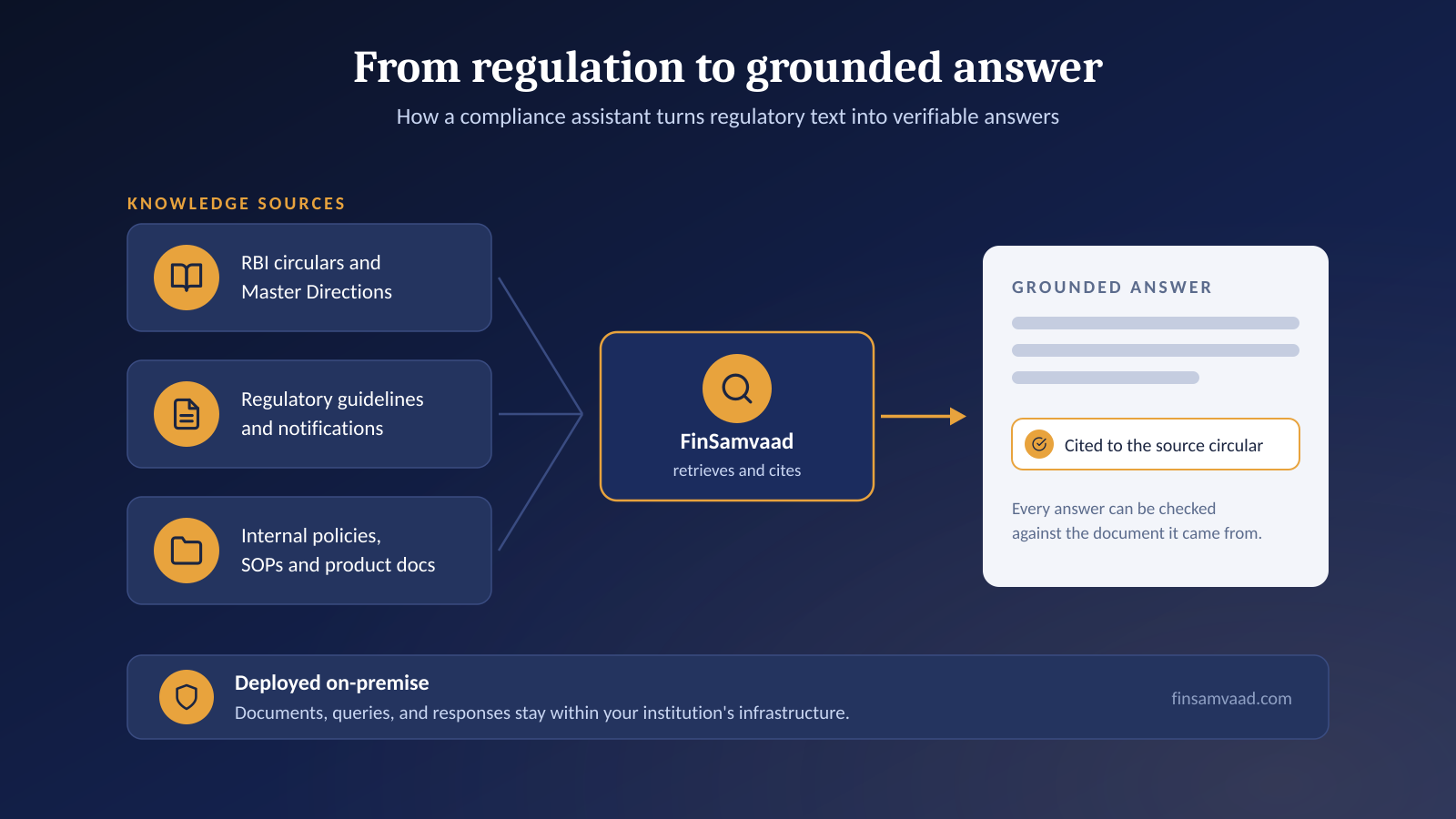
FinSamvaad retrieves from regulatory and internal documents, and cites every answer to its source.
- Grounded answers with source citations. Every answer is retrieved from RBI circulars, Master Directions, regulatory notifications, and the institution's own documents, and is cited so it can be checked against the source in seconds.
- Built for Indian financial institutions. The system is designed around RBI's regulatory structure and the terminology banks and NBFCs actually use, not adapted to it after the fact.
- Internal knowledge included. Policies, SOPs, and product documentation sit alongside the regulatory corpus, so questions that span both, such as whether an internal process meets a regulatory requirement, can be answered in one place.
- On-premise deployment. Documents, queries, and responses stay within the institution's infrastructure and never leave its environment.
What changes day to day
The practical effect is a shift in how compliance knowledge moves through the institution. Questions that queued for a specialist get a cited first answer in seconds, with the specialist's time reserved for judgment rather than retrieval. New circulars arrive as concise summaries instead of unread PDFs. Different teams asking the same question get the same answer, traced to the same source. And when a question genuinely has no supported answer, the system says so rather than improvising, which is exactly the behavior an auditor wants to see.
None of this replaces compliance expertise. It changes what that expertise is spent on: less time hunting through documents, more time applying judgment to what they say.
See it on your own documents
FinSamvaad is built by KnowDis AI, the New Delhi team behind AI search and language systems serving some of India's largest e-commerce platforms. To see FinSamvaad answer questions on RBI regulation and your institution's own policies, book a demo at finsamvaad.com or write to us at info@knowdis.ai.