

Ask an AI assistant for a company's quarterly revenue and you will get a number. It will be formatted correctly, delivered fluently, and placed in a sentence that sounds like it came from an annual report. Whether it is the actual number is a separate question, and here is the uncomfortable part: the real figure and the invented one look identical on screen.
This is the hallucination problem, and in most settings it is an inconvenience. In finance it is something else entirely, because the people asking usually cannot verify the answer, and the decisions they make on it involve their money.
At KnowDis, we spent the better part of our work on FinSamvaad, our financial question answering system for Indian finance, treating hallucination not as a bug to patch but as the central design constraint. This post explains why financial hallucinations happen, why they are costlier than most teams assume, and what measurably reduces them.
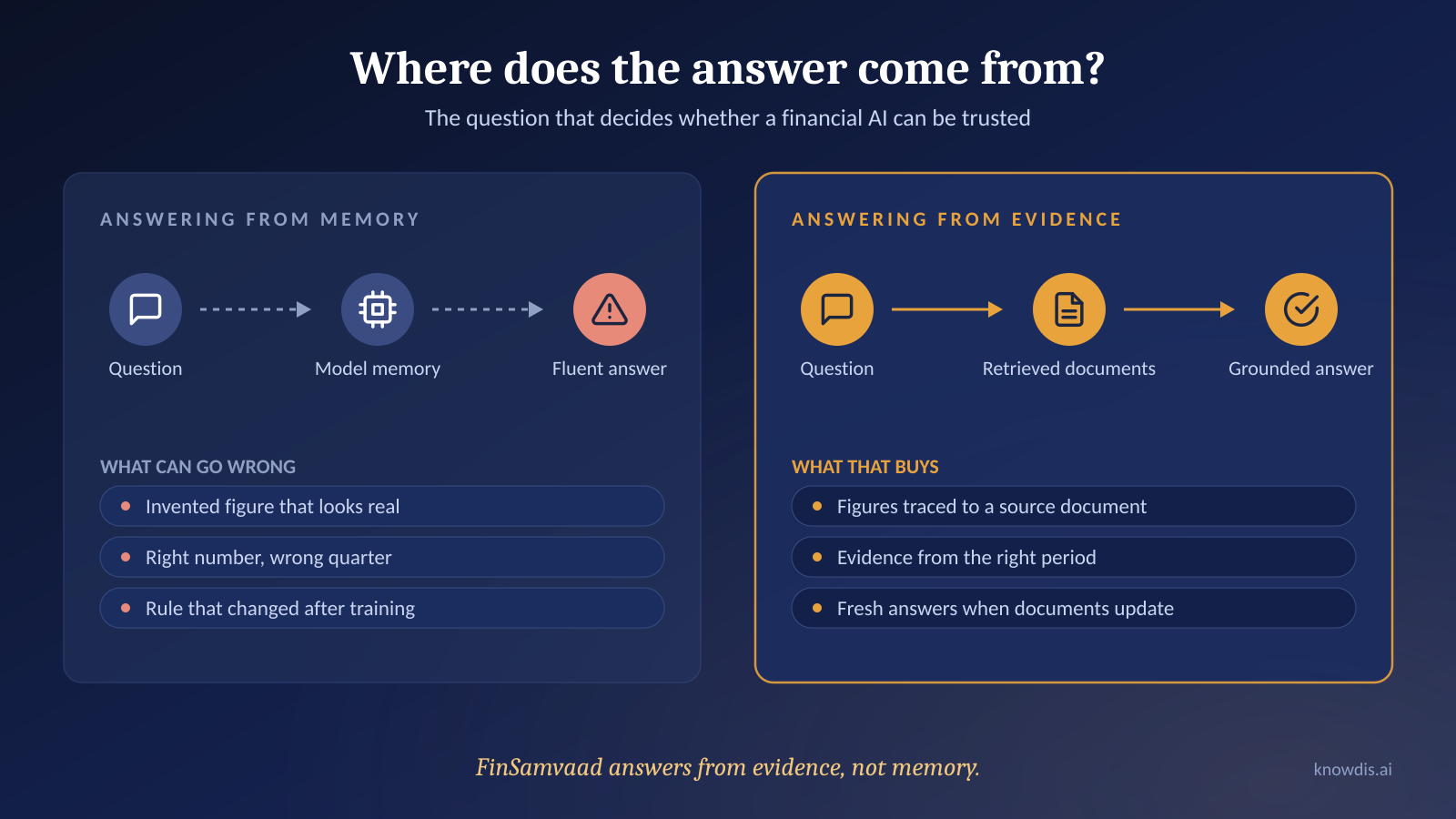
Hallucination is not a glitch. It is the default.
Language models are trained to continue text plausibly. That objective is what makes them fluent, and it is also why they invent. When a model is asked for a fact it does not reliably hold, nothing in its design makes it stop. It produces the most statistically likely-looking answer instead, with the same fluent confidence it uses for facts it actually knows.
Three properties make this worse in practice. The model has no internal signal separating remembered facts from plausible inventions. Its confidence does not track its accuracy, so tone is useless as a warning. And it has no native sense of time, so even a fact it genuinely absorbed may be quoted from the wrong year.
None of this is fixed by better prompting, and only partially by larger models. A system that answers from memory will sometimes answer from imagination. The fix has to change where answers come from.
Why finance is the worst place to hallucinate
Every domain suffers hallucination. Finance concentrates the damage, for three reasons.
The asker usually cannot verify. A developer spots a hallucinated API in seconds, because the code fails. A person asking about a mutual fund's returns, a loan's eligibility rules, or a company's results often has no quick way to check. The whole reason they asked is that they did not know.
Financial facts expire. Interest rates move, regulations get amended, results get restated every quarter. An answer that was true in March can be false, and actionable, in October. A model quoting its training data is always quoting the past.
Errors compound into decisions. A wrong number does not stay on the screen. It flows into a savings choice, a credit application, an investment, where being wrong has a price attached. And each bad answer a user catches taxes the product twice: once in the harm done, once in the trust lost. Trust in financial products is slow to earn and fast to spend.
Put together, finance is a domain where the median user cannot audit the answer, the ground truth shifts quarterly, and the downside is monetary. That is about the hardest environment you could design for a system that improvises.
The three shapes of a financial hallucination
Watch enough model output in this domain and the failures sort into three recognizable patterns.
The invented figure. The model needs a specific number, does not hold it, and produces one that fits the format: a revenue with the right magnitude, an interest rate in the right range. This is the purest hallucination, and the hardest for a reader to catch, precisely because it is calibrated to look normal.
The period mix-up. The number is real, but belongs to a different quarter or year. These are subtler than inventions: a user who checks will find the figure genuinely exists, just not where the model claimed. In our evaluations, question types that depend on pulling values from the right period, like calculation and table-based queries, are where ungrounded models degrade most.
The stale rule. The model quotes a regulation, limit, or eligibility criterion that was once true and has since changed. Nothing was invented. The world moved, and the model's memory did not.
The second and third patterns matter because they defeat the usual advice of "just double-check the AI." A fabricated number fails a check. A real number from the wrong period, or a rule that was true last year, can pass one.
What measurably reduces it: grounding
The common thread in all three patterns is that the model answered from memory. The fix is to stop asking it to. Retrieval-grounded systems first fetch the relevant documents, then have the model compose its answer from that evidence. Each failure pattern is addressed at the source: figures come from a document rather than imagination, the retriever can prefer evidence from the right period, and updating the corpus updates the answers without retraining.
This is the architecture behind FinSamvaad, and the effect shows up in measurement. In LLM-as-a-Judge evaluation across 3,864 curated financial queries, the grounded pipeline scored 4.54 out of 5 on answer quality against 4.19 for a much larger ungrounded baseline, with the widest gaps on exactly the query types where hallucination bites hardest: calculation questions (4.61 vs 3.66), extraction (4.63 vs 4.10), and table-based queries (4.59 vs 4.11). Retrieval quality itself scored 4.89 out of 5, and that is the driver: when the right evidence is in front of the model, it has far less room, and far less need, to invent.
Grounding is not a silver bullet. A retriever can surface the wrong passage, and a model can still misread a document. But it converts an unbounded problem, a model free to imagine anything, into a bounded one, a model constrained by what the documents say. Bounded problems can be measured, audited, and improved.
A buyer's checklist: five questions to ask any financial AI
If you are evaluating an AI system for financial use, these five questions separate grounded systems from fluent guessers.
-
Where did this number come from? Ask the vendor to show the source document behind a specific answer. A grounded system can point to one. A memorizing system cannot.
-
What happens on an unanswerable question? Ask something the corpus cannot support. The right behavior is to say so. The wrong behavior is a fluent, invented answer.
-
How does it handle periods? Ask the same question about two different quarters and check that the answers differ, and differ correctly.
-
How do answers get updated? If the only path is retraining the model, every fact in the system is aging. If updating the document corpus updates the answers, freshness is operational, not aspirational.
-
How is hallucination measured? Ask for the evaluation setup: how many queries, judged how, against what baseline. A vendor who cannot describe one has not measured the thing that matters most.
None of these require technical depth to ask. All of them are hard to fake.
The bar for financial AI
The question for financial AI is not whether it sounds knowledgeable. Every modern model does. The question is whether its answers are anchored to evidence, aware of time, and honest about their limits. That is the bar we built FinSamvaad to meet: grounded, time-aware, multilingual financial intelligence for India.
FinSamvaad is built by KnowDis AI, the New Delhi team behind AI search and language systems serving some of India's largest e-commerce platforms. To explore bringing FinSamvaad to your organization, write to us at info@knowdis.ai or visit www.knowdis.ai.
Figures are from internal LLM-as-a-Judge benchmarking across 3,864 curated financial queries, comparing the FinSamvaad pipeline against a 70B-parameter baseline. Results reflect our evaluation setup and may vary with other datasets and configurations.